
Where to Invest in 2026: Balancing Safety and Growth

Introduction
The following chart depicts performance of asset classes in the past decade (FY2016-FY2015), reinforcing a timeless lesson: equities build wealth, gold protects it, debt stabilises, and real estate demands patience and liquidity discipline. Returns from investment in gold & silver has been extra-ordinary or exceptionally high in the past few years due to geo-political reasons. Returns from investment in any asset class in the past may not repeat in the future.
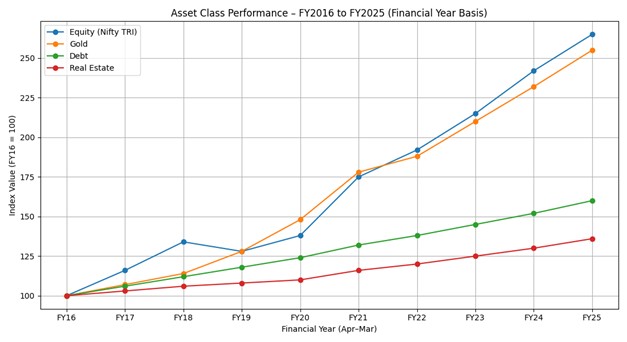
As 2026 approaches, Indian investors stand at an interesting crossroads of development growth and opportunities in new emerging areas. There has been tremendous geopolitical uncertainty but also remarkable technological progress in recent past, especially in AI, green energy, and digital finance. India continues to shine as the world’s fastest-growing major economy, investors are asking the key question:
“Where should I invest in 2026 to balance safety and growth?”
The answer lies in diversifying their investments via carefully designed mix of equity (in emerging sectors), debt, gold, real estate and digital assets, depending upon individual’s risk appetite and investment goals.
The Economic Backdrop for 2026
The Indian economy enters 2026 on strong footing:
- GDP growth likely to remain above 6.5%, supported by manufacturing, infrastructure, and services.
- Inflation expected to remain below 5%.
- RBI may gradually lower policy rates, improving credit growth and market liquidity.
- Government spending on defence, railways, and renewable energy shall continue to drive domestic demand.
Globally, geo-political conditions, pressures in major economies, supply chain shifts, central banks’ monetary policies, global supply & demand in commodities especially crude oil, gold and silver, and climate policies will shape market sentiment. In short — volatility may persist, but opportunities are plenty.
Equity: The Engine of Long-Term Growth
A. Focus on Sectors with Structural Growth
2026 favours sectors backed by government initiatives and long-term demand:
- Defence & Aerospace: Supported by “Make in India” and rising export potential.
- Artificial Intelligence & Automation: Benefiting from digital transformation.
- Green & Renewable Energy: Solar, EV, and battery storage industries gaining global traction.
- Infrastructure & Capital Goods: Driven by India’s ongoing capex cycle.
B. Ideal Investment Routes
- Large-Cap & Flexi-Cap Mutual Funds: Diversify investment in pure equity in Large/ Mid/ Small / Flexi cap or Index funds which offer good growth if invested on long term basis. Avoid large exposure to small cap, sectoral or theme-based funds.
- Equity oriented hybrid or Balance Advantage Funds: For less risk, stability with growth.
- ELSS (Tax-saving equity funds): Dual benefit of tax saving and growth. Lock-in period of 5 years is good for healthy long-term growth.
- Direct Stocks: For seasoned investors who have the knack of selecting stocks on strong fundamentals. Avoid investment on short-term hype, and in greed or fear.
- International Funds: Exposure to global innovation themes like AI and semiconductors.
- NPS: Provides excellent provision in Tier1 & Tier2 accounts to choose balance between equity and debt exposure according to risk appetite. Tier1 provides additional advantage of locking the investment till the age of 60/75 for retirement planning, allowing corpus to compound exponentially.
Debt and Fixed-Income: For Steady and Stable Returns
After years of rising interest rates and returns from stock market, 2026 could be the year of steady income from fixed-income products.
Recommended Options:
- Short- to Medium-Duration Debt Funds: To benefit from falling yields or interest rates as the NAV of such Funds or prices of these Bonds rise which result in higher gains.
- Target Maturity Funds (TMFs): These give predictable returns with lower interest-rate risk.
- Debt-oriented Hybrid Funds: For stability with some equity growth.
- Corporate Bonds & PSU Bonds: Investment in these Bonds or FDs provide higher (presently around 8%–11%) yield with moderate risk. But one must diversify investment in high rated (min. 80% in A category) Bonds to ensure safety with growth.
- Senior Citizen Savings Schemes (SCSS) & RBI Bonds: These are excellent investment options and safe bets for senior citizens and conservative investors.
A balanced portfolio should hold 20–30% in fixed income for stability.
Gold and Silver: The Timeless Hedge
Geopolitical uncertainty, central bank buying, and rupee depreciation keep gold attractive.
In 2026, one can aim to allocate 10–15% of your portfolio to:
- Sovereign Gold Bonds (SGBs) – Though Indian Govt. has stopped issuing Sovereign Gold Bonds but one can invest in these Bonds through secondary market to earn extra 2.5% annual interest plus price appreciation.
- Gold ETFs or Funds – provide easy liquidity and no storage worries.
- Silver ETFs – an emerging investment theme driven by increasing use of silver in industries relating to semi-conductors, renewable energy and EV components. But volatility in silver prices makes it a risky investment, so investment through SIPs may be advisable.
Please note that Investment in digital gold may be risky as these may not be backed by equivalent purchase in real/physical gold and such investment are not governed or regulated under SEBI rules.
Real Estate and REITs (Real estate investment Trusts): Earning from Urban Real Estate Boom
India’s urban housing market remains strong due to income growth and rising homeownership aspirations.
Key Ideas:
- Residential Property: Prefer Tier-1 & Tier-2 cities and emerging suburbs with infrastructure projects.
- Investment in residential plot generates much more return than in apartment.
- Home or construction loan EMI should not be normally more than 30% of your monthly income to avoid wastage on loan interest and stress in the event of job loss. Take home loan to spend on EMI instead of rent.
- Commercial REITs: Offer 6–8% annual yield and steady rental income.
- Data Centre and Logistics REITs: Expected to expand with India’s digital and e-commerce growth.
A balanced portfolio may include up to 5%-10% investment in REITs as well.
Emerging Asset Class: Crypto and Digital Gold
While risky, digital assets like Bitcoin and Ethereum have shown increasing trend as decentralized alternatives and have given handsome return over a longer time horizon.
- Limit exposure (preferably via SIPs) to 2–3% of your portfolio being highly volatile in nature.
- Use regulated Indian exchanges like CoinDCX or WazirX.
- Treat it as a long-term speculative bet, not a core investment.
Model Portfolios for 2026
Investor Type | Equity | Debt/Fixed Income | Gold/Silver | REITs | Crypto/Other |
Conservative | 30% | 50% | 10% | 10% | 0% |
Balanced | 50% | 30% | 10% | 8% | 2% |
Aggressive | 70% | 15% | 10% | 3% | 2% |
Smart Investing Tips for 2026
- First keep an emergency or liquid fund aside worth 6 months of expenses, vacations, etc. so that you need not to touch investment money.
- Purchase Health, Term, Home and Motor insurance type necessary insurances to avoid wiping off savings during any unfortunate accident or health emergency.
- Then diversify investment according to risk appetite and investment goals keeping in mind no single asset class wins every year, hence aim for long term diversified investments.
- Avoid lump-sum investment in any non-debt instrument, better to adopt SIP route or systematic transfer from debt/fixed income to non-debt instrument, to handle volatility with safety.
- If you can afford, never discontinue SIPs during market downturns, in fact you get more MF units for the same money, which gives handsome returns when the market rebounds. Time in the market matters more than timing the market.
- Review your portfolio every 6–8 months and keep balancing according to your goals and risk appetite.
- Preservation of capital is important. Systematic transfer from equity to fixed instruments may be done on achievement of investment goals near peak market levels, or if depreciation is noticeable due to stressed economical or geo-political reasons.
- Avoid trading or investing following social media hype.
- Invest for goals — not for quick profits.
- Stay invested till investment goal is achieved or unless money is required under emergency conditions.
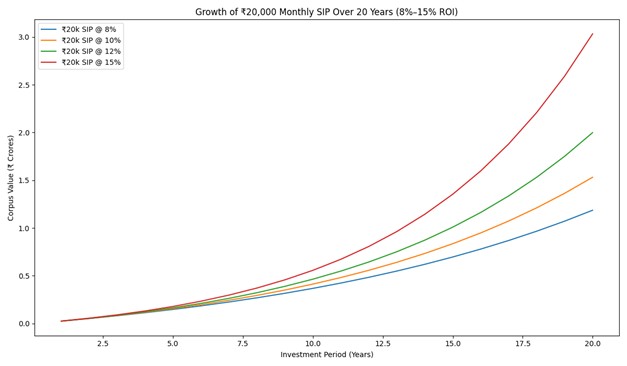
- Refer chart above on 20k monthly SIP returns in 20 years. Compounding gives magical effect, never miss it and stay invested to reap magical compounding returns in later years of investment when the invested money multiplies exponentially, and thereby you can also achieve financial freedom earlier in your life. Time of investment, amount of investment and %age rate of return determine the final value of investment. Increased SIP on regular basis will bring even better results.
- Keep in mind taxation part on returns applicable to you while doing investments, consult tax expert if needed.
Conclusion
India’s long-term growth story is intact, but volatility will be part of the journey. The most successful investors in 2026 will be those who plan smartly, diversify wisely, and stay invested patiently.